

Spinal Remodeling Traction in Fargo, ND
When we tell a patient their care plan includes traction, they have an idea that it might pull their spine while laying down, an inversion table in their friend’s basement, or an over the door bag from a physical therapy visit in 2003.
In our clinic, we emphasize the importance of Spinal Remodeling Traction for optimal results.
That picture is not what we do in our clinic.
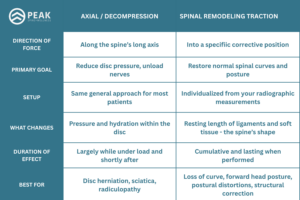
Conventional traction pulls a spine apart. Spinal remodeling traction changes a spines shape. Those are different goals, different setups, different physics and different results!
Axial Traction Vs. Remodeling Traction
Axial (linear) traction – reducing pressure
Axial traction applies a force along the length of the spine, pulling the vertebrae away from one another. Inversion tables, standard traction tables and modern decompression all work this way.
The goal is pressure reduction. Separate the vertebrae and you lower the pressure inside the disc, open the space a compressed nerve travels through and encourage fluid back into dehydrated disc tissue. This is genuinely valuable and it is why decompression works for herniated discs and radiating nerve pain.
Spinal Remodeling Traction not only helps with pressure reduction but also enhances overall spinal health.
Unlike axial traction, Spinal Remodeling Traction actively reshapes your spine for better alignment and function.
Remodeling Traction – Changing Structure
Remodeling traction applies a sustained, low load force in a specific direction, positioning your spine into the opposite of its distortion and holding it there long enough for the soft tissue to adapt.
If your neck curve is flattened, you’re positioned into extension over a precisely placed fulcrum. If your head translates forward, the setup drives it backward. If you carry a lateral translation to the right, the force runs to the left. The direction is determined by your Digital X-ray measurements. Which also makes care customized to every patient we see.
They are not competitors. Many of our patients receive both as decompression addresses discs and remodeling traction is used to correct the alignment of the spine, which is often overlooked to begin with.
How Remodeling Traction Actually Works
Understanding how Spinal Remodeling Traction works is essential for appreciating its benefits.
The mechanism is worth understanding because it explains why the time on the table matters so much.
Ligaments and discs are viscoelastic. That means their response to load depends on how long the load is applied, not just how hard. When applying a gentle sustained force overtime, the tissues slowly starts to change.
This is the same principle behind orthodontics. Braces do not move teeth with force; they move teeth with gentle force applied continuously over months. Your ligaments respond to sustained load the same way.
The published biomechanical work on this is specific about timing. Ligamentous change is spinal ligaments begins withing about five minutes of sustained loading, with roughly twenty minutes identified as the optimal duration. That is why CBP protocols run ten to twenty minutes per session, and why sessions are repeated several times weekly. This is about steady, cumulative change, rather than a single dramatic correction.
Adjustments alone do not reliably change spinal alignment. An adjustment is a fast, brief force. It restores motion, reduces nerve irritation and interference from the nervous system along with helping you to feel better. The loading duration required for viscoelastic change simply is not present. Systematic review authors have made the point that sustained, continuous nature of the loading is likely the reason manipulation on its own does not routinely correct spinal alignment.
It’s crucial to combine adjustments with Spinal Remodeling Traction for effective long-term outcomes.
What Research Shows
A systematic review of controlled trails on cervical extension traction methods found consistent improvement in cervical lordosis across studies, with reported increases of 12 to 18 degrees after roughly 30-40 traction sessions. This was measured radiographically, not estimated.
The clinical outcomes attached to those structural changes have been examined in randomized trials, with several long follow-up periods. Restoring cervical alignment has been associated with improvement outcomes in cervicogenic headaches at two years, cervicogenic dizziness and head positioning accuracy at one year, and in cervical radiculopathy. In the cervical radiculopathy outcome, a two year trail measured not only pain but objectively verified better nerve root function. Other systemic reviews document lumbar lordosis restoration in the treatment of low back disorders, and randomized work on reducing thoracic hyperkyphosis reports improved pain and disability outcomes maintained long-term.
What Your Traction Looks Like
When you choose Spinal Remodeling Traction, you are opting for a tailored approach to spinal health.
It starts with measurements of your spine. Nothing is prescribed until we’ve completed your posture evaluation and radiographic analysis. Your set up which involves the direction the spine needs to go, fulcrum placement, angle and load, are all determined from those numbers.
Each session of Spinal Remodeling Traction is designed based on your unique spinal measurements.
You build gradually. Most patients begin with about three minutes and add time each session working to 12-15 minutes.
It is passive. You are positioned and supported, and then you rest into that position. Nothing is being forced. Most patients listen to something or close their eyes.
Mild soreness early on is normal. You are loading tissue in a direction it has not been loaded in years, so a stiff or achy feeling for a day after your first few sessions is expected and usually settles as your body adapts. Sharp pain, radiating symptoms, dizziness, or anything that lingers is not expected. If this is the case, we will change the traction setup.
It works alongside everything else. Adjustments restore motion, therapeutic exercise builds the muscular support that holds the correction, and traction changes the structure. Any one of these on its own gives you a part of a result.
Incorporating Spinal Remodeling Traction into your treatment plan can lead to lasting changes.
We re-measure. Comparative imaging at an appropriate point shows what actually changed, in degrees and millimeters. That is the standard we hold ourselves to.
Frequently Asked Questions about Spinal Remodeling Traction
Is this the same as the traction I had at physical therapy?
Almost certainly not. Standard clinical traction is typically axial which means it pulls along the length of the spine to reduce pressure. Remodeling traction positions your spine into a specific corrective shape based on your own x-ray measurements and hold it there. Different direction, different purpose, and different outcomes.
Is remodeling traction the same as spinal decompression?
No, though they are complementary and many patients receive both. Decompression is axial and targets disc pressure and nerve compression. Remodeling traction targets alignment. If you have a herniated disc caused partly by loss of lumbar curve, you may need both.
Many patients discover that Spinal Remodeling Traction complements other therapies they receive.
Does it hurt?
It should not hurt. The load is gentle by design. Viscoelastic change comes from duration rather than intensity. Mild soreness is the first week is common as tissue adapts. Anything sharper than that means the setup needs adjusting, and we’d rather hear about it early.
How long before my curve actually changes?
Over time, Spinal Remodeling Traction can significantly improve your spinal curvature.
Structural change is measured in months. The controlled trails reporting 12 to 18 degrees of cervical lordosis improvement did so across roughly 30 to 40 sessions. Many patients feel considerably earlier than that, which is encouraging but is not the same as structural work being finished.
Can I just buy a traction device online and do this at home?
Home traction orthotics are a real part of many care plans. The direction, fulcrum, placement, and duration must match your specific distortion, and you can’t determine those without measuring your spine. Traction applied in the wrong direction can reinforce the pattern you’re trying to correct. Get measured first, then we’ll tell you what belongs at home.
Will the correction hold once I stop?
This is exactly why traction is paired with corrective exercise and stabilization phase. Traction creates change and the supporting musculature is what maintains it once you’re out living your life. Patients who complete the stabilization phase hold their correction substantially better than those who stop as soon as they feel good.
Patients often notice substantial benefits after completing their Spinal Remodeling Traction sessions.
See What Your Spine Is Actually Doing
Whether remodeling traction is right for you depends on what your measurements show. That is where we start.
Call (701) 532-0823 or schedule online.
References
With regular Spinal Remodeling Traction, maintaining spinal alignment becomes easier.
-
- Oakley PA, Ehsani NN, Moustafa IM, Harrison DE. Restoring cervical lordosis by cervical extension traction methods in the treatment of cervical spine disorders: a systematic review of controlled trials. J Phys Ther Sci.2021;33(10):784-794.
- Oakley PA, Ehsani NN, Moustafa IM, Harrison DE. Restoring lumbar lordosis: a systematic review of controlled trials utilizing Chiropractic BioPhysics non-surgical approach to increasing lumbar lordosis in the treatment of low back disorders. J Phys Ther Sci. 2020;32(9):601-610.
- Harrison DE, Cailliet R, Harrison DD, Janik TJ, Holland B. A new 3-point bending traction method for restoring cervical lordosis and cervical manipulation: a nonrandomized clinical controlled trial. Arch Phys Med Rehabil.2002;83(4):447-453.
- Oakley PA, Harrison DE. Reducing thoracic hyperkyphosis subluxation deformity: a systematic review of Chiropractic BioPhysics methods employed in its structural improvement. J Contemp Chiropr. 2018;1:59-66.
- Moustafa IM, Diab AA, Harrison DE. The effect of normalizing the sagittal cervical configuration on dizziness, neck pain, and cervicocephalic kinesthetic sensibility: a 1-year randomized controlled study. Eur J Phys Rehabil Med.2017;53(1):57-71.
Spinal Remodeling Traction offers a unique approach to correcting spinal distortions effectively.
- Moustafa IM, Diab AA, Harrison DE. The efficacy of cervical lordosis rehabilitation for nerve root function and pain in cervical spondylotic radiculopathy: a randomized trial with 2-year follow-up. J Clin Med. 2022;11(21):6515.
$99 New Patient Special
Includes:
Many patients choose Spinal Remodeling Traction to enhance their overall quality of life.
-
- Consultation
- Thorough Health History
- Chiropractic Exam
- Postural Analysis
- X-rays if indicated
Being proactive with Spinal Remodeling Traction can prevent future spinal issues.
- Report of Findings
How Our Spinal Decompression Plan Works
1. Corrective
Integrating Spinal Remodeling Traction into your care plan can yield significant health improvements.
This initial stage focuses on addressing specific spinal misalignments and dysfunctions. Through targeted adjustments and specialized techniques, the goal is to restore proper alignment and function to the spine. This phase often involves intensive care to correct existing issues and alleviate pain.
2. Stabilization
The stabilization stage aims to reinforce the changes made. This involves strengthening surrounding muscles, improving posture, and ensuring that the spine maintains its proper alignment over time. Patients typically engage in exercises and receive ongoing adjustments to support long-term stability.
3. Wellness
The final stage emphasizes maintaining optimal spinal health and overall well-being. Wellness care involves regular check-ups and adjustments to prevent future issues and support a healthy lifestyle. This proactive approach helps patients maintain their progress, enhance quality of life, and promote overall health and wellness.
Many patients find that Spinal Remodeling Traction is a key component in their recovery.
Read Our Online Reviews




Check Out Our Location Near You
3260 Veterans Blvd Suite 105, Fargo, ND 58104
Start Your Health Journey
Spinal Remodeling Traction is an essential part of achieving optimal health.
Explore the benefits of Spinal Remodeling Traction during your next visit.